

Design principles of lipid nanoparticles for RNA delivery
脂质纳米颗粒用于 mRNA 递送的结构设计与优化
February 2026Nature Reviews Bioengineering 4(5):417-434
DOI:10.1038/s44222-026-00401-1
脂质纳米颗粒用于RNA递送的设计原则 2026年2月《自然·生物工程评论》4(5):417-434
摘要
脂质纳米颗粒可通过促进RNA封装、细胞摄取和核内体逃逸,实现蛋白质表达的精确控制,从而作为RNA疗法的安全有效递送载体。除了在预防性疫苗中的既定作用外,含RNA的脂质纳米颗粒制剂正在癌症免疫治疗、蛋白质替代和基因治疗领域得到探索。在本综述中,我们探讨了RNA-脂质纳米颗粒制剂的设计前景,详细介绍了其关键组分、形成过程、理化性质和表征方法。我们讨论了脂质纳米颗粒组成成分的组成和化学计量比如何影响递送效率、组织靶向性和体内清除。名远后,我们从工程和转化角度,重点介绍了主要的治疗应用,并概述了未来的发展方向。
关键点:
脂质纳米颗粒是美国食品药品监督管理局(FDA)批准的若干产品中的关键成分,包括新冠肺炎mRNA疫苗。
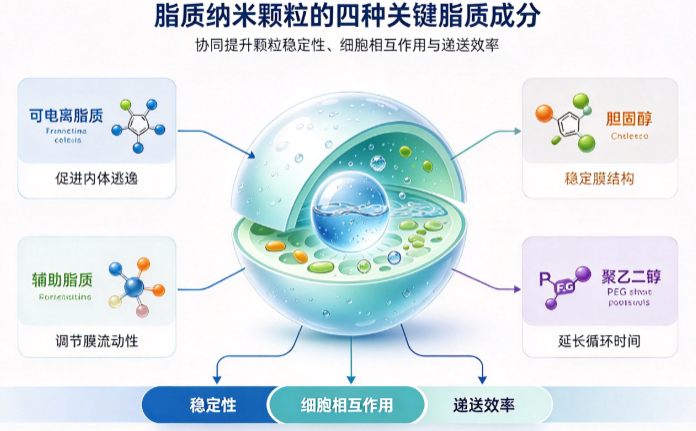
脂质纳米颗粒包含四种脂质成分:可电离脂质、胆固醇、辅助脂质和聚乙二醇(PEG)脂质,每种成分都对颗粒稳定性、细胞相互作用和递送效率有所贡献。
可电离脂质的化学多样性推动了脂质纳米颗粒效能和耐受性的逐步提升,其中合成脂质MC3、SM-102和ALC-0315已纳入临床获批产品之列。
通过调节可电离脂质和辅助脂质的化学性质,可以将脂质纳米粒的递送从肝脏重定向到其他部位,包括肺部和胰腺。
剩余的挑战包括进入难以触及的组织、控制蛋白质冠层相互作用、名远小化免疫反应以及提高制剂稳定性。
Lipid nanoparticles can serve as safe and effective delivery vehicles for RNA therapies by facilitating RNA encapsulation, cell uptake and endosomal escape, enabling precise control of protein expression. Beyond their established role in prophylactic vaccines, formulations of lipid nanoparticles with RNA are being explored in cancer immunotherapy, protein replacement and gene therapy. In this Review, we examine the design landscape of RNA–lipid-nanoparticle formulations, detailing their key components, formation, physicochemical properties and methods of characterization. We discuss how the composition and stoichiometry of the constituents of lipid nanoparticles influence delivery efficiency, tissue targeting and clearance in vivo. Finally, we highlight major therapeutic applications and outline future directions from both engineering and translational perspectives. Lipid nanoparticles can serve as carriers for RNA therapies, enabling efficient encapsulation, cellular uptake and controlled protein expression. This Review explores their design principles, key components, physicochemical properties and therapeutic potential, highlighting how formulation parameters influence delivery performance.