
作者:
Jun Wang, Tingting Li, Jen-Shyang Ni, Heng Guo, Tianyi Kang, Zeshun Li, Menglei Zha,
Songbo Lu, Chen Zhang, Weizhi Qi, Lei Xi,* and Kai Li
引用瑞禧生物产品:
1,2-Distearoyl-snglycero-3-phosphoethanolamine-N-[methoxy(polyethylene glycol)-2000]
(DSPE-PEG2000) and 1,2-distearoyl-sn-glycero-3-phosphoethanolamine-N- [amino(polyethylene glycol)-2000] (DSPE-PEG2000-NH2)
摘要:
Precise and efficient delivery of nanomedicine to the target site has remained as a major roadblock in advanced cancer treatment. Here, a novel photoacoustic force (PAF)-guided nanotherapeutic system is reported based on a near-infrared (NIR)-absorbing semiconducting polymer (SP), showing significantly improved tumor accumulation and deep tissue penetration for enhanced phototherapeutic efficacy. The accumulation of nanoparticles in 4T1 tumor-bearing mice induced by the PAF strategy displays a fivefold enhancement in comparison with that of the traditional passive targeting pathway, in a significantly shortened time (45 min vs 24 h) with an enhanced penetration depth in tumors. Additionally, a tumor-bearing mouse model is rationally designed to unveil the mechanism, indicating that the nanoparticles enter solid tumors through enhanced transportation across blood vessel barriers via both inter-endothelial gaps and active trans-endothelial pathways. This process is specifically driven by PAF generated from the nanoparticles under NIR laser irradiation. The study thus demonstrates a new nanotherapeutic strategy with low dose, enhanced delivery efficiency in tumor, and boosted therapeutic efficacy, opening new doors for designing novel nanocarriers.
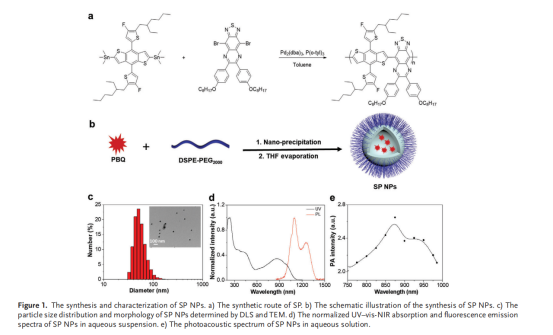
图1. SP NPs的合成与表征。a) SP的合成路线。b) SP NPs合成的示意图。c) 通过DLS和TEM测得的SP NPs的粒径分布及形貌。d) SP NPs在水性悬浮液中的归一化紫外-可见- NIR 吸收光谱与荧光发射光谱。e) SP NPs在水溶液中的光声光谱。
将纳米药物精准且高效地递送至靶部位,一直是先进癌症治疗中的主要障碍。本文报道了一种基于近红外(NIR)吸收半导体聚合物(SP)的新型光声力(PAF)引导纳米治疗系统,该系统在肿瘤蓄积量和深层组织穿透性方面均有显著提升,从而增强了光疗效果。在4T1荷瘤小鼠中,采用PAF策略诱导的纳米颗粒蓄积量较传统被动靶向途径提高了五倍,且所需时间显著缩短(45分钟 vs 24小时),同时在肿瘤中的穿透深度也显著增加。此外,本研究合理设计了荷瘤小鼠模型以揭示其作用机制,结果表明纳米颗粒通过内皮细胞间隙及主动跨内皮途径,增强穿越血管屏障的能力,终进入实体瘤。这一过程主要由纳米颗粒在 NIR 激光照射下产生的PAF驱动。本研究 thus 展示了一种新型纳米治疗策略,其特点包括低剂量、高肿瘤递送效率及增强的治疗效能,为设计新型纳米载体开辟了新途径。