

作者:
Zhe Ma 1,2,3,†, Jiaxin Pi 1,2,3,†, Ying Zhang 1,2,3, Huan Qin 1,2,3, Bing Zhang 1,2,3, Nan Li 1,2,3, Zheng Li 1,2,4,* and Zhidong Liu 1,2,
引用瑞禧生物产品:
DSPE-Hyd-PEG5K-FA and DSPE-PEG5K-FA
Abstract:
The poor ability of recognition and penetration of chemotherapeutic agents to tumor cells are still great challenges for targeted breast cancer treatment. Herein, we established a tumor-targeted nanostructured lipid carrier encapsulating gambogic acid (GA) and paclitaxel (PTX), which was co-modified with acid-cleavable folic acid (cFA) and a human-derived cell penetrating peptide dNP2 (CKIKKVKKKGRKKIKKVKKKGRK). The multi-functional nano-platform exhibited an enhanced targeting and penetrability to tumor tissues, which was accomplished by the combined action of cFA and dNP2. After intravenous injection, firstly, cFA could actively target the breast cancer tissues by the selective recognition of folate receptor (FR); then, upon arrival at the tumor microenvironment, the acid-cleavable FA and dNP2 dual modified nanostructured lipid carrier (cFA/dNP2-GA/PTX NLC) exhibited sensitive cleavage of folic acid (FA), which could reduce the hindrance effect of FA to maximize the dNP2 cell-penetrating properties. The effect of different modification on cellular uptake, in vivo bio-distribution, and anticancer activity of NLCs proved our hypothesis that compared with NLCs modified by non-cleavable FA or a single ligand, cFA/dNP2-GA/PTX-NLC displayed more efficient intracellular delivery, stronger targeting ability in vivo, improved cytotoxicity on 4T1 cells, and produced the better therapeutic efficacy of GA and PTX. The strategy affords a feasible way to overcome the poor recognition and permeability of medicines in cancer treatment.
Keywords: breast cancer; gambogic acid; paclitaxel; cell penetrating peptide; pH sensitive folic acid
摘要:
化疗药物对肿瘤细胞的识别与渗透能力不足,仍是靶向乳腺癌治疗面临的重大挑战。本研究建立了一种肿瘤靶向纳米结构脂质载体,该载体封装了藤黄酸(GA)与紫杉醇(PTX),并共修饰了可酸裂解的叶酸(cFA)及人源细胞穿透肽dNP2(ckikkvkkkgrkkikkvkkkgrk)。这一多功能纳米平台通过cFA与dNP2的协同作用,显著提升了对肿瘤组织的靶向性与渗透性。静脉注射后,cFA首先通过选择性识别叶酸受体(FR)主动靶向乳腺癌组织;随后,当抵达肿瘤微环境时,可酸裂解的FA与dNP2双修饰纳米结构脂质载体(cFA/dNP2-GA/ PTXNLC)可灵敏地裂解叶酸(FA),从而减轻FA的阻碍效应,大化dNP2的细胞穿透性能。不同修饰方式对纳米脂质载体细胞摄取、体内生物分布及抗癌活性的影响证实了我们的假设:与仅修饰不可裂解FA或单一配体的纳米脂质载体相比,cFA/dNP2-GA/ PTX -NLC展现出更高效的细胞内递送能力、更强的体内靶向能力、对4T1细胞更强的细胞毒性,以及更优的GA与 PTX 治疗效果。该策略为克服癌症治疗中药物识别率与渗透性不足的问题提供了一种可行方案。关键词:乳腺癌;藤黄酸;紫杉醇;细胞穿透肽;pH敏感性叶酸
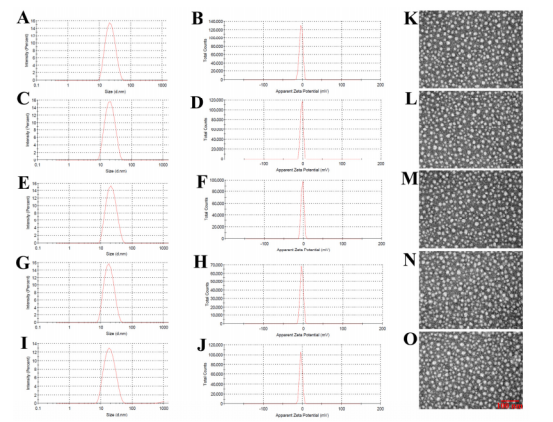
图1. 制剂的粒径与形貌:(A–J) 分别为 GA/ PTXNLC 、dNP2-GA/ PTX -NLC、FA-GA/ PTX -NLC、FA/dNP2-GA/ PTX -NLC 及 cFA/dNP2-GA/ PTX -NLC 的粒径分布与 zeta 电位;数据均通过动态光散射法测定。(K–O) 分别为上述制剂的 TEM 图像(标尺 = 100 nm)。