

作者:
Ying Ding,[a, b] Weimin Liu,* [a, b] Jiasheng Wu,[a] Xiuli Zheng,[a] Jiechao Ge,[a, b] Haohui Ren,[a]Wenjun Zhang,[c] Chun-Sing Lee,[c] and Pengfei Wang* [a, b]
引用瑞禧生物产品:
DSPE-mPEG2000
╴╴╴╴╴╴╴╴╴╴╴╴╴╴╴╴╴╴╴╴╴╴╴╴╴╴╴╴╴╴╴╴╴╴╴╴╴╴╴╴╴╴╴╴╴╴╴╴╴╴╴╴╴╴╴╴╴
Abstract:
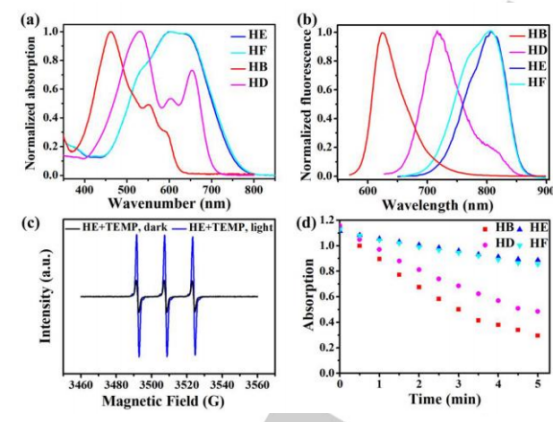
Hypocrellin B (HB) derived from naturally produced hypocrellins has attracted considerable attention in photodynamic therapy (PDT) because of its excellent photosensitive properties. However, the weak absorption within a “phototherapy window” (600– 900 nm) and poor water solubility of HB have limited its clinical application. In this study, two HB derivatives (i.e., HE and HF) were designed and synthesized for the first time by introducing two different substituent groups into the HB structure. The obtained derivatives showed a broad absorption band covering the near-infrared (NIR) region, NIR emission (peaked at 805 nm), and singlet oxygen quantum yields of 0.27/0.31. HE-PEG-NPs were also prepared using 2-distearoyl-sn-glycero-3-phosphoethanolamine-N-[methoxy(polyethyleneglycol)-2000] (DSPE-mPEG2000) to achieve excellent dispersion in water and further explored their practical applications. HE-PEG-NPs not only retained their 1O2-generating ability, but also exhibited a photothermal conversion efficiency of 25.9%. In vitro and in vivo therapeutic results revealed that the synergetic effect of HE-PEG-NPs on PDT and photothermal therapy (PTT) could achieve a good performance. Therefore, HE-PEG-NPs could be regarded as a promising phototheranostic agent.