
作者:
Ying Long,a Zhou Wang,a Jialong Fan,a Liqin Yuan,b Chunyi Tong, a Yanzhong Zhao*c and Bin Liu *a
引用瑞禧生物产品:
DSPE-PEOz2K
Abstract:
Although drug combination has proved to be an efficient strategy for clinic gastric cancer therapy, how to further improve their bioavailability and reduce the side effects are still challenges due to the low solubility and untargeted ability of drugs. Recently, newly emerging nanotechnology has provided an alternative for constructing new drug delivery systems with high targeting ability and solubility. In this study, a pH-responsive liposome (Liposome-PEO, LP) loaded with apatinib (AP) and cinobufagin (CS-1) was used for combinational therapy against gastric cancer after coating with a hybrid membrane (R/C). The results indicated that the constructed nanocomplex LP-R/C@AC not only efficiently killed tumor cells in vitro by inducing apoptosis, autophagy, and pyroptosis, but also significantly inhibited tumor invasion and metastasis via the VEGFR2/STAT3 pathway. Moreover, it showed stronger anti-tumor activity in gastric cancer-bearing mouse models, as compared to the sole drugs. A naturally-derived hybrid cell membrane coating bestowed nanocomplexes with enhanced biointerfacing including prolonged circulation time and targeting ability
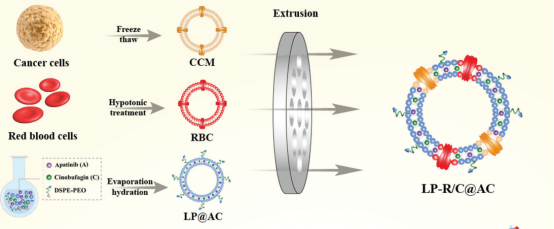
A)展示了杂化膜修饰双药物纳米载体系统 LP-R/C@AC NPs 的制备流程。该系统以 pH 响应性脂质体为核心,负载阿帕替尼(AP)和辛诺巴星(CS-1),并通过红细胞/癌细胞杂化膜包衣,最终形成兼具靶向性、稳定性和肿瘤微环境响应释放能力的纳米复合物。