

作者:
Yifei Wang,a,b,c Ruiting Wang,a,b Sixuan Wu,a,b Jingyi An,a,b Yan Liang,a,b Lin Hou*a,b,c and Zhenzhong Zhang *a,b,c
引用瑞禧生物产品:
EGCG
一、研究背景与科学问题
二、研究思路与设计策略
三、作用机制与*肿瘤效应
四、文献图谱简析
ABSTRACT
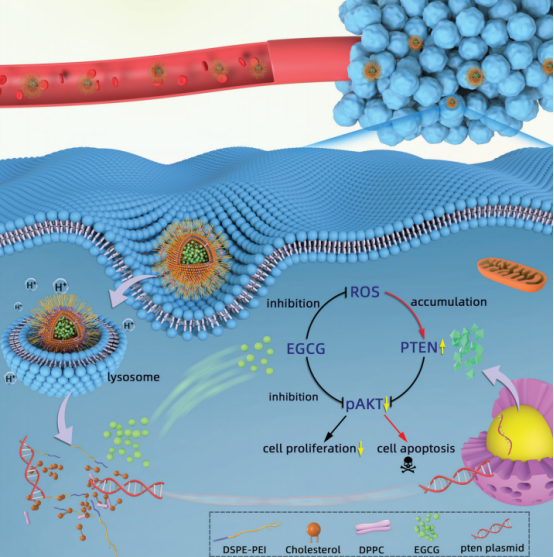
Delivering the pten gene into tumor cells to reacquire PTEN functionality is considered to be an attractive method for cancer treatment. However, the inhibition effect of the tumor intracellular microenvironment (TIME), especially at the high reactive oxygen species (ROS) level, on pten expression and PTEN protein functionality was nearly overlooked. Herein, the development of a potential strategy is described, which enhances PTEN-mediated anti-tumor capability by exhausting the intracellular ROS in TIME. To achieve this, poly(ethyleneimine) (PEI)-modified DSPE was introduced to protect the pten plasmid, and form liposomes for encapsulating the “scavenger” of oxidation homeostasis, epigallocatechin-3-gallate (EGCG). Notably, this was a simple system with improved safety compared which when compared with the use of PEI could accomplish efficient pten transfection and simultaneous disintegration to cause transient release of EGCG responding to the endosome environment through the “proton sponge effect”. In the cytoplasm, EGCG depleted ROS and promoted the expression of the pten gene as well as restoring protein functionality, thus negatively regulating the PI3K–AKT signaling pathway. In vitro and in vivo results revealed that this system significantly inhibited tumor growth via remodeling of the TIME, and provided a promising way to control malignant tumors.