

作者:
Chunlai Fenga , Haisheng Zhanga , Jiaming Chena , Siqi Wanga , Yuanrong Xina , Yang Qua , Qi Zhanga , Wei Jia , Fumiyoshi Yamashitab , Mengjie Ruia,⁎ , Ximing Xua,⁎⁎
引用瑞禧生物产品:
(DSPE-PEG-FITC)
研究背景与临床痛点
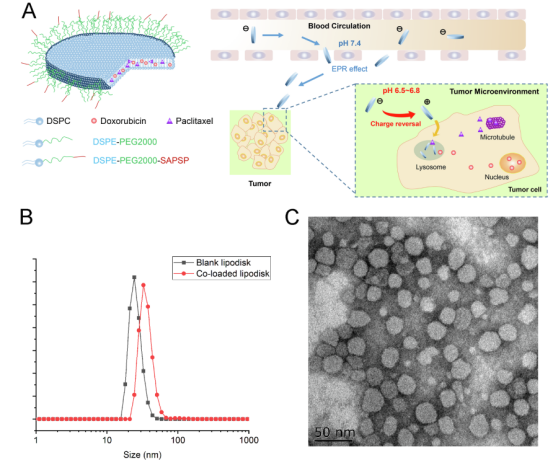
创新制剂设计:肿瘤靶向脂质盘
- 比例化共负载:能够将DOX与PTX按特定比例负载于同一脂质盘中,确保药物同步转运。
- 功能肽修饰:整合了一种弱酸性pH敏感性肽(SAPSP),这不仅显著增强了制剂的肿瘤靶向性,还有效提升了细胞内化效率。
理化性质表征
- 粒径大小:所得共负载脂质盘的直径约为30 nm,属于纳米级颗粒,有利于在体内的循环与渗透。
- 环境响应性:制剂表现出显著的pH敏感性,能够响应肿瘤微环境或细胞内的酸性环境。
- 制备与形貌:如图1所示,通过薄膜水化法成功制备了含药脂质盘。流体动力学直径测试及透射电镜(TEM)图像均证实了纳米颗粒的形态与尺寸均一性。
体外细胞毒性评价
- 更强的细胞毒性:与游离药物相比,共载脂质盘对培养的肿瘤细胞表现出更强的杀伤力。
- 克服耐药性:该系统对耐药性肿瘤细胞(MCF-7/ADR)的抑制效果尤为显著。
- 协同效应:在特定的协同药物比例下,脂质盘发挥了最良好的抗癌效果。
体内抗肿瘤活性与机制
- 作用机制:这种显著的抑制作用主要归因于两种药物在肿瘤组织中实现了“比例性累积”,从而在病灶部位维持了最良好的协同浓度。
- 临床意义:研究证实,肿瘤特异性脂质盘对于DOX与PTX的联合治疗至关重要,能够全面发挥协同抗癌效应。
结论与展望
╴╴╴╴╴╴╴╴╴╴╴╴╴╴╴╴╴╴╴╴╴╴╴╴╴╴╴╴╴╴╴╴╴╴╴╴╴╴╴╴╴╴╴╴╴╴╴╴╴╴╴╴╴╴╴╴╴
ABSTRACT
Combination therapy is a promising treatment for certain advanced drug-resistant cancers. Although effective inhibition of various tumor cells was reported in vitro, combination treatment requires improvement in vivo due to uncontrolled ratiometric delivery. In this study, a tumor-targeting lipodisk nanoparticle formulation was developed for ratiometric loading and the transportation of two hydrophobic model drugs, doxorubicin (DOX) and paclitaxel (PTX), in one single platform. Furthermore, a slightly acidic pH-sensitive peptide (SAPSP) incorporated into lipodisks effectively enhanced the tumor-targeting and cell internalization. The obtained coloaded lipodisks were approximately 30 nm with a pH-sensitive property. The ratiometric co-delivery of two drugs via lipodisks was confirmed in both the drug-resistant MCF-7/ADR cell line and its parental MCF-7 cell line in vitro, as well as in a tumor-bearing mouse model in vivo compared with a cocktail solution of free drugs. Coloaded lipodisks exerted improved cytotoxicity to tumor cells in culture, particularly to drug-resistant tumor cells at synergistic drug ratios. In an in vivo xenograft mouse model, the anti-tumor ability of co-loaded lipodisks was evidenced by the remarkable inhibitory effect on tumor growth of either MCF-7 or MCF-7/ADR tumors, which may be attributed to the increased and ratiometric accumulation of both drugs in the tumor tissues. Therefore, tumor-specific lipodisks were crucial for the combination treatment of DOX and PTX to completely exert a synergistic anti-cancer effect. It is concluded that for co-loaded lipodisks, cytotoxicity data in vitro could be used to predict their inhibitory activity in vivo, potentially enhancing the clinical outcome of synergistic therapy