

作者:
Tianlin Zhoua , Jinrong Penga , Ying Haoa , Kun Shia , Kai Zhoua , Yun Yanga , Chengli Yanga , Xinlong Hea , Xinmian Chenb , Zhiyong Qiana,
引用瑞禧生物产品:
DSPE-PEG-FITC and DSPE-PEG-Mannose
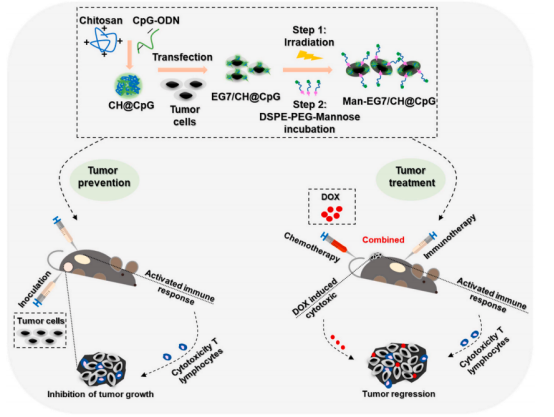
一、示意图整体结构与逻辑层次
- 本示意图采用“材料制备—体内递送—细胞互作—效应输出”的四阶段线性布局,从左至右按时间逻辑展开,完整呈现从疫苗构建到体内抗肿瘤效应的全流程。
- 整体视觉风格采用低饱和度暖色调配色体系,所有分子、细胞与功能模块图标保持统一扁平化设计,避免高对比度红绿配色,符合SCI期刊对色盲友好性的出版规范。
- 全图信息层级清晰,通过不同粗细的实线、虚线与箭头区分物质递送、信号激活与效应传导三类不同作用关系,核心机制路径用稍粗箭头重点突出,非必要冗余元素全部移除,保证审稿人可在3秒内捕捉核心逻辑。
二、左侧模块:Man-EG7/CH@CpG 新型肿瘤细胞疫苗制备流程
- 起始单元为EG7淋巴瘤全肿瘤细胞,首先通过致死性辐照处理,诱导肿瘤细胞发生免疫原性细胞死亡(ICD),释放内源性肿瘤相关抗原,同时保留细胞完整骨架作为天然抗原载体。
- 第二步展示壳聚糖浓缩的CpG-ODN佐剂复合物(CH@CpG)通过静电吸附作用进入辐照后肿瘤细胞内部,完成抗原载体与免疫佐剂的共装载。
- 第三步呈现DSPE-PEG-甘露糖靶向配体通过磷脂插入方式锚定在EG7细胞外层细胞膜表面,最终完成Man-EG7/CH@CpG双重改良疫苗的完整构建。
- 本模块所有分子结构标注均符合生物化学术语规范,壳聚糖、CpG-ODN、DSPE-PEG-Mannose等关键组分的化学结构简化示意准确,无专业术语标注错误。
三、中间模块:体内递送与树突状细胞(DC)靶向激活过程
- 皮下免疫给药后的Man-EG7/CH@CpG疫苗,通过局部组织间隙向引流淋巴结迁移,表面修饰的甘露糖配体可特异性识别并结合DC表面高表达的甘露糖受体。
- 图中用定向箭头直观展示甘露糖配体与DC表面受体的结合过程,对比未修饰肿瘤细胞疫苗的非特异性吞噬路径,突出靶向修饰后DC对疫苗的吞噬效率显著提升的核心优势。
- 疫苗进入DC细胞后,CpG-ODN靶向激活胞内TLR9信号通路,促进DC成熟与抗原交叉呈递,该过程用胞内信号分子的递进式图标清晰呈现,明确佐剂的免疫激活机制。
四、右侧模块:免疫激活与联合化疗的协同抗肿瘤效应
- 成熟DC将肿瘤抗原呈递给初始T细胞,诱导肿瘤特异性CD8⁺细胞毒性T细胞大量增殖,启动后续适应性抗肿瘤免疫应答,该部分用T细胞形态变化与数量扩增的序列图标直观展示。
- 同步呈现序贯给予的化疗药物多柔比星(DOX)的作用路径:DOX进入残留淋巴瘤细胞后,通过损伤肿瘤细胞DNA发挥直接杀伤作用,同时进一步诱导肿瘤细胞发生免疫原性死亡,释放更多新抗原。
- 图中用双向协同箭头连接免疫治疗通路与化疗通路,明确展示两种治疗方式的互补增益关系:DOX的化疗杀伤作用降低肿瘤负荷,疫苗诱导的特异性免疫应答清除微小残留病灶,二者协同打破肿瘤免疫抑制微环境。
- 最终效应单元标注联合治疗组约85%的肿瘤生长抑制率,同时对比单疫苗组、单DOX化疗组的抗肿瘤效果差异,直观体现序贯联合方案的疗效优势。
五、示意图细节规范与出版适配说明
- 全图所有标注字体统一采用无衬线字体,字号保持在8-12号区间,导出分辨率设置为600 dpi,可直接满足国内核心期刊与绝大多数SCI期刊的图件投稿要求。
- 图中所有细胞类型、分子名称与信号通路术语均与正文表述完全对应,图注可直接配套补充各步骤样本量设置、实验检验方法与统计学显著性标记说明,无需额外调整。
- 本研究涉及的核心功能材料DSPE-PEG-Mannose、DSPE-PEG-Chitosan、DSPE-PEG-DOX等磷脂-PEG偶联物,均可提供不同分子量、修饰比例的现货规格,同时支持定制化合成服务,满足后续机制验证与动物实验的材料需求。
╴╴╴╴╴╴╴╴╴╴╴╴╴╴╴╴╴╴╴╴╴╴╴╴╴╴╴╴╴╴╴╴╴╴╴╴╴╴╴╴╴╴╴╴╴╴╴╴╴╴╴╴╴╴╴╴╴
ABSTRACT
In recent years, Non-Hodgkin lymphoma (NHL) has been one of the most fast-growing malignant tumor diseases. NHL poses severe damages to physical health and a heavy burden to patients. Traditional therapies (chemotherapy or radiotherapy) bring some benefit to patients, but have severe adverse effects and do not prevent relapse. The relevance of emerging immunotherapy options (immune-checkpoint blockers or adoptive cellular methods) for NHL remains uncertain, and more intensive evaluations are needed. In this work, inspired by the idea of vaccination to promote an immune response to destroy tumors, we used a biomaterial-based strategy to improve a tumor cell-based vaccine and constructed a novel vaccine named Man-EG7/CH@CpG with antitumor properties. In this vaccine, natural tumor cells are used as a vector to load CpG-ODN, and following lethal irradiation, the formulations were decorated with mannose. The study of the characterization of the doubleimproved vaccine evidenced the enhanced ability of DCs targeting and improved immunocompetence, which displayed an antitumor function. In the lymphoma prevention model, the Man-EG7/CH@CpG vaccine restrained tumor formation with high efficiency. Furthermore, unlike the non-improved vaccine, the double-improved vaccine elicited an enhanced antitumor effect in the lymphoma treatment model. Next, to improve the moderate therapeutic effect of the mono-treatment method, we incorporated a chemotherapeutic drug (doxorubicin, DOX) into the process of vaccination and devised a combination regimen. Fortunately, a tumor inhibition rate of ~85% was achieved via the combination therapy, which could not be achieved by mono-chemotherapy or mono-immunotherapy. In summary, the strategy presented here may provide a novel direction in the establishment of a tumor vaccine and is the basis for a prioritization scheme of immuno-chemotherapy in enhancing the therapeutic effect on NHL.