
作者:
Mengyu Chen, Yuexin Cui, Wenyan Hao, Yueyue Fan, Jingqiu Zhang, Qianqian Liu, Mingrui Jiang, Yang Yang, Yingzi Wang & Chunsheng Gao
引用瑞禧生物产品:
DSPE-PEG2000-NHS
 ABSTRACT
The main treatment measure currently used for glioma treatment is chemotherapy; the biological barrier of solid tumors hinders the deep penetration of nanomedicines and limits anticancer therapy. Furthermore, the poor solubility of many chemotherapeutic drugs limits the efficacy of antitumor drugs. Therefore, improving the solubility of chemotherapeutic agents and drug delivery to tumor tissues through the blood–brain barrier (BBB) and blood–brain tumor barrier (BBTB) are major challenges in glioma treatment. Nanostructured lipid carriers (NLCs) have high drug loading capacity, high stability, and high in vivo safety; moreover, they can effectively improve the solubility of insoluble drugs. Therefore, in this study, we used solvent volatilization and ultrasonic melting methods to prepare dihydroartemisinin nanostructured lipid carrier (DHA-NLC). We further used the glioma C6 cancer cell (CC) membrane to encapsulate DHA-NLC owing to the homologous targeting mechanism of the CC membrane; however, the targeting ability of the CC membrane was weak. We accordingly used targeting ligands for modification, and developed a bionanostructured lipid carrier with BBB and BBTB penetration and tumor targeting abilities. The results showed that DHA-loaded NGR/CCNLC (asparagine–glycine–arginine, NGR) was highly targeted, could penetrate the BBB and BBTB, and showed good antitumor effects both in vitro and in vivo, which could effectively prolong the survival time of tumorbearing mice. Thus, the use of DHA-loaded NGR/CCNLC is an effective strategy for glioma treatment and has the potential to treat glioma.
- 当前治疗现状:目前,化疗是胶质瘤治疗的主要手段之一。
- 面临的主要障碍:
- 生物学屏障限制:实体瘤的生物学屏障严重阻碍了纳米药物向肿瘤深部的渗透,限制了整体抗癌疗效。
- 药物理化性质制约:许多化疗药物存在溶解度低的问题,进一步制约了抗肿瘤药物的作用发挥。
- 核心科学问题:如何提高化疗药物的溶解度,并克服血脑屏障(BBB)和血脑肿瘤屏障(BBTB)将药物有效递送至胶质瘤组织,已成为该领域的主要挑战。
- 良好的载体特性:NLCs具备高载药量、高稳定性以及良好的体内安全性。
- 功能拓展:能够有效提高不溶性药物的溶解度,是改善疏水性化疗药物递送的理想平台。
- 基础载体构建:本研究采用溶剂挥发法联合超声熔融法制备了双氢青蒿素纳米结构脂质载体(DHA-NLC)。
- 同源靶向尝试与优化:
- 初步利用胶质瘤C6癌细胞(CC)膜包被DHA-NLC,期望借助CC膜的同源靶向机制实现靶向递送。
- 鉴于CC膜自身靶向能力较弱的局限性,研究进一步引入靶向配体进行修饰。
- 最终载体构建:成功开发出兼具BBB/BBTB穿透能力与高效肿瘤靶向能力的生物纳米结构脂质载体(NGR/CCNLC)。
- 靶向与穿透能力:实验结果表明,负载DHA的NGR/CCNLC(修饰配体为天冬酰胺-甘氨酸-精氨酸序列)具有高度的靶向性,能够有效穿透BBB和BBTB。
- 体内外疗效:该载体在体外和体内实验中均展现出良好的抗肿瘤效果,并能有效延长荷瘤小鼠的生存期。
- 策略总结:使用载有DHA的NGR/CCNLC是一种有效的胶质瘤治疗策略。
- 应用前景:该纳米递送系统展现出显著的治疗胶质瘤潜力。
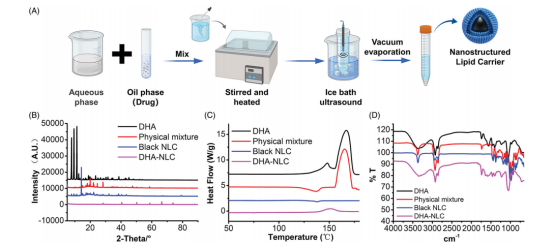
- 图内容:展示了双氢青蒿素纳米结构脂质载体的制备与表征过程。
- (A) 制备工艺示意图:以固体脂质、液体脂质、表面活性剂和药物构成油相,稳定剂溶于水相,通过溶剂蒸发超声熔融法制备纳米结构脂质载体。
- (B-D) 表征图谱:包括纳米结构脂质载体各组分的X射线衍射图谱(XRD)、差示扫描量热法(DSC)扫描曲线以及傅里叶变换红外光谱(FTIR)图。