

作者:
Daijia Shen1 Lianhua Zhu1 Yu Liu1 Yanli Peng2 Minmin Lan2 Kejing Fang1 Yanli Guo1* 1Department of Ultrasound, Southwest Hospital, Third Military Medical University (Army Medical University), Shapingba District, Chongqing, China
引用瑞禧生物产品:
(DPPA), (DPPE), (DPPC) and(DSPE-PEG2000-COOH)
- 总体目标:构建一种多功能靶向纳米气泡,实现乳腺癌的靶向诊断与协同治疗。
- 具体策略:将小分子CXCR4拮抗剂AMD070与光吸收材料吲哚菁绿(ICG)共同负载于纳米气泡中,系统评估其在体外多模态成像中的表现,并深入探究其对乳腺癌细胞生长的抑制机制与治疗疗效。
- 纳米气泡制备:通过碳二亚胺化学反应结合机械振荡法,成功制备携带AMD070及ICG的靶向纳米气泡(ICG-TNBs),并对其物理特性及体外多模态成像能力进行测定。
- 靶向结合验证:利用激光共聚焦显微镜观察ICG-TNBs与人乳腺癌细胞的特异性结合能力。
- 疗效与机制评估:
- 采用CCK-8法及流式细胞术,分析ICG-TNBs联合超声处理(ICG-TNBs+US)对肿瘤细胞增殖的抑制作用及促凋亡效应。
- 通过流式细胞术与Western blotting技术,检测活性氧(ROS)生成水平,并从分子层面解析相关信号通路机制。
- 物理特性:ICG-TNBs的粒径为497.0±29.2 nm,Zeta电位为-8.05±0.73 mV,符合纳米递送系统的基本要求。
- 体外成像性能:体外多模态成像结果显示,ICG-TNBs的图像信号强度与其浓度呈正相关,具备良好的浓度依赖性成像能力。
- 靶向特异性:靶向结合实验证实,ICG-TNBs可特异性结合CXCR4阳性的人乳腺癌MCF-7细胞,而不与CXCR4阴性的MDA-MB-468细胞结合,展现出良好的靶向选择性。
- 抗肿瘤疗效:CCK-8检测及流式细胞术分析表明,ICG-TNBs联合超声处理能显著抑制MCF-7乳腺癌细胞的生长,并有效促进其凋亡。
- 作用机制解析:流式细胞术与Western blot分析揭示,ICG-TNBs+US处理可显著增加ROS的生成,同时降低CXCR4的表达,抑制Akt蛋白的磷酸化,并上调Caspase3及Cleaved-caspase3的表达。这表明该纳米气泡能有效抑制并阻断SDF-1/CXCR4信号通路,从而诱导MCF-7细胞凋亡。
- 核心发现:ICG-TNBs可特异性靶向结合CXCR4阳性乳腺癌细胞,通过阻断SDF-1/CXCR4信号通路,在联合超声照射的条件下,进一步抑制肿瘤细胞生长并促进其凋亡。
- 研究意义:本研究提出了一种整合乳腺癌靶向诊断与治疗的新型概念、方法及作用机制,为乳腺癌的精准诊疗提供了新思路。
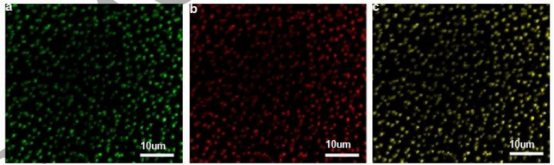
- a图:展示用DiO荧光染料标记的ICG-TNBs。
- b图:展示携带ICG的ICG-TNBs自身的荧光信号。
- c图:合并图像(Merge)清晰证实,ICG已成功包裹于ICG-TNBs中,实现了双重荧光信号的共定位。
╴╴╴╴╴╴╴╴╴╴╴╴╴╴╴╴╴╴╴╴╴╴╴╴╴╴╴╴╴╴╴╴╴╴╴╴╴╴╴╴╴╴╴╴╴╴╴╴╴╴╴╴╴╴╴╴╴
Abstract: Objective: To construct targeted nanobubbles carrying both small-molecule CXCR4 antagonist AMD070 and light-absorbing material indocyanine green (ICG), and to study their in vitro multimodal imaging, as well as their mechanism and efficacy of inhibition of breast cancer cell growth.
Methods: Nanobubbles carrying AMD070 and ICG (ICG-TNBs) were constructed by carbodiimide reaction and mechanical oscillation. The physical characteristics and in vitro multimodal imaging were determined. The binding potential of ICG-TNBs to human breast cancer cells were observed by laser confocal microscopy. CCK-8 and flow cytometry were used to analyze the role of ICG-TNBs+US in inhibiting proliferation and inducing apoptosis of tumor cells. Flow cytometry and Western blotting are used to analyse the ROS generation and molecular mechanisms.
Results: ICG-TNBs had a particle size of 497.0±29.2 nm and a Zeta potential of -8.05±0.73 mV. In vitro multimodal imaging showed that the image signal intensity of ICG-TNBs increased with concentration. Targeted binding assay confirmed that ICG-TNBs could specifically bind to MCF-7 cells (CXCR4 positive), but not to MDA-MB-468 cells (CXCR4 negative). CCK-8 assay and flow cytometry analysis showed that ICG-TNBs+US could significantly raise generation of ROS, reduce the expression of CXCR4,inhibit phosphorylation of Akt, and increase the expression of Caspase3 and Cleaved-caspase3. This indicated that ICG-TNBs could effectively inhibit and block the SDF-1/CXCR4 pathway, thus leading to the apoptosis of MCF-7 cells.
Conclusion: ICG-TNBs can specifically bind to CXCR4 positive breast cancer cells, furthermore inhibit growth and promote apoptosis of breast cancer cells combined with ultrasonic irradiation by blocking the SDF-1/CXCR4 pathway. This study introduces a novel concept, method and mechanism for integration of targeted diagnosis and treatment of breast cancer.
Key words: Targeted Nanobubbles, multimodal imaging, targeted therapy, CXCR4, breast cancer