

作者:
Teng Hou1 , Tianqi Wang1 , Weiwei Mu1 , Rui Yang1 , Shuang Liang1 , Zipeng Zhang1 , Shunli Fu1 , Tong Gao1 , Yongjun Liu1 *, Na Zhang1 *
引用瑞禧生物产品:
DSPE-rhodamine B
一、研究背景:细胞疗法为何“有力而未竟”
- 细胞疗法的潜力来自其“活体药物”属性,而非单纯的杀伤效力。
- 制约因素是 TME 的复杂性与免疫抑制性,属系统性障碍,非单靶点可解。
- 由此引出一个设计问题:能否让治疗细胞同时承担“破围栏”和“送药”两件事。
二、策略提出:“细胞—化疗”的双功能设计
- 功能一:作为免疫治疗工具,直接参与重塑 TME。
- 功能二:作为靶向递送载体,把化疗药定向送入肿瘤。
- 关键点在于两种功能由同一细胞承担,递送过程本身即伴随免疫效应。
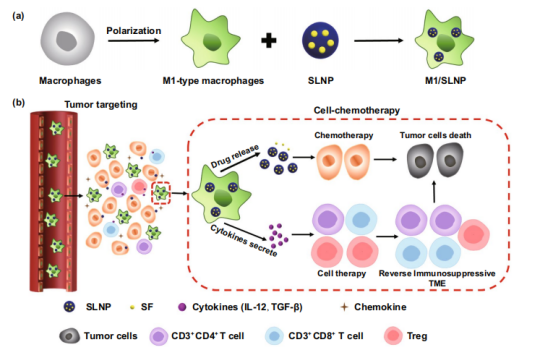
三、体系构建:M1/SLNPs 的制备(对应图 1a)
- 第一步:LPS 极化,获得具促炎表型与肿瘤趋向性的 M1 型巨噬细胞。
- 第二步:M1 细胞与 SLNP 共孵育,形成 M1/SLNP 复合体系。
- 图 1a 呈现的正是这一制备流程;图注宜写明极化和孵育这两步,避免读者误以为颗粒是在细胞内原位合成的。
四、靶向递送:积累量显著提升
- 对照组:单纯 SLNP;实验组:M1/SLNP。
- 结果:肿瘤组织内积累量显著升高(p < 0.01)。
- 推论:M1 细胞介导的主动靶向是富集增加的主要来源,这是后续疗效差异的物质基础。
五、免疫微环境:从“抑制”转向“激活”
- 固有免疫层面:M1/M2 比值升高,促炎/抑炎平衡向*肿瘤一侧移动。
- 适应性免疫层面:CD4⁺ 与 CD8⁺ T 细胞数量增加,效应细胞浸润改善。
- 两者叠加,说明该体系不只是“送药”,还在改写 TME 的免疫格局。
六、*肿瘤疗效:疗效优势得到验证
- 主要终点:肿瘤体积,M1/SLNP 组显著小于 SLNP 组(p < 0.01)。
- 证据链:靶向富集增加 → 免疫抑制缓解 → 肿瘤生长受抑。
- 结论边界:现有对照只覆盖“是否搭载 M1 细胞”这一变量。
七、意义与展望
- 范式层面:细胞既是治疗主体,也是递送工具,二者不再割裂。
- 转化层面:工艺简洁,但需解决细胞制备的标准化与可放大性。
- 待答问题:M1 细胞在体内的存活与表型维持、长期安全性、与现有方案的联合空间。
╴╴╴╴╴╴╴╴╴╴╴╴╴╴╴╴╴╴╴╴╴╴╴╴╴╴╴╴╴╴╴╴╴╴╴╴╴╴╴╴╴╴╴╴╴╴╴╴╴╴╴╴╴╴╴╴╴
ABSTRACT
Cell therapy is a promising strategy for cancer therapy. However, its therapeutic efficiency remains limited due to the complex and immunosuppressive nature of tumor microenvironments. In this study, the “cell-chemotherapy” strategy was presented to enhance antitumor efficacy. M1-type macrophages, which are therapeutic immune cells with both of immunotherapeutic ability and targeting ability, carried sorafenib (SF)-loaded lipid nanoparticles (M1/SLNPs) were developed. M1-type macrophages were used both as therapeutic tool to provide immunotherapy and as delivery vessel to target deliver SF to tumor tissues for chemotherapy simultaneously. M1-type macrophages were obtained by polarizing macrophages using lipopolysaccharide, and M1/ SLNPs were obtained by incubating M1-type macrophages with SLNP. Tumor accumulation of M1/SLNP was increased compared with SLNP (p <0.01), which proved M1/SLNP could enhance tumor targeting of SF. An increased ratio of M1-type macrophages to M2-type macrophages, and the CD3+CD4+ T cells and CD3+CD8+ T cell quantities in tumor tissues after treatment with M1/SLNP indicated M1/SLNP could relieve the immunosuppressive tumor microenvironments. The tumor volumes in the M1/SLNP group were significantly smaller than those in the SLNP group (p<0.01), indicating M1/SLNP exhibited enhanced antitumor efficacy. Consequently, M1/SLNP showed great potential as a novel cellchemotherapeutic strategy combining both cell therapy and targeting chemotherapy.
KEYWORDS Polarized-macrophages; Cell therapy; Cell-mediated drug delivery; Chemotherapy;Lipid nanoparticles