
作者:
Luoping Zhai1 Chuangwei Luo1 Hannan Gao1 Shuaifan Du1 Jiyun Shi 2 Fan Wang1–3
引用瑞禧生物产品:
DSPE-PEG2000-MAL
一、DOPE-DVar7-lip@DOX纳米载体的分步制备流程
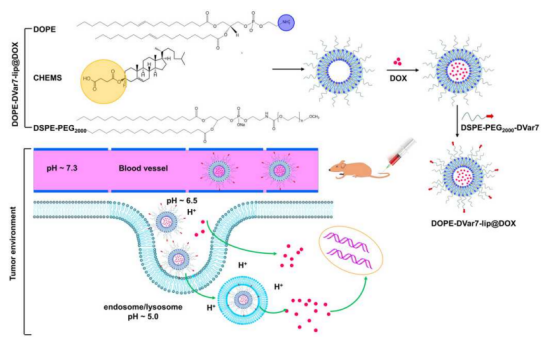
- 载药基础脂质体构建:以酸敏感性磷脂DOPE为核心膜材,结合辅助脂质组分,通过薄膜水化-超声分散法制备空白DOPE脂质体;利用阿霉素(DOX)弱碱性理化特性,采用主动载药法将DOX包封于DOPE脂质体内部水相,构建得到载药基础载体DOPE-lip@DOX,完成化疗药物DOX的封装与初步稳定包载。
- 靶向肽表面修饰:将合成得到的DSPE-DVar7(磷脂-酸性插入肽偶联物)与DOPE-lip@DOX进行简单共孵育,依靠疏水相互作用实现DSPE片段锚定于脂质体磷脂双分子层,完成DVar7肽段在脂质体表面的定向修饰,最终制得双pH响应型纳米制剂DOPE-DVar7-lip@DOX,整个制备工艺条件温和,可保持DOX药物活性与脂质体结构稳定性。
二、肿瘤酸性微环境下DVar7介导的靶向滞留与膜融合机制
- 酸性触发DVar7构象变构:正常生理pH条件下,DVar7肽段呈无规卷曲松散构象;当纳米载体随血液循环富集至肿瘤组织,在肿瘤酸性微环境(pH 6.5~6.8)刺激下,DVar7发生pH依赖性构象转变,折叠组装形成稳定α螺旋空间结构,暴露疏水作用区域,获得膜插入活性。
- 肿瘤细胞膜嵌入与滞留增强:变构后的α螺旋DVar7可特异性插入肿瘤细胞膜磷脂双分子层,实现脂质体在肿瘤细胞膜表面的锚定,显著提升肿瘤组织对脂质体的摄取效率,同时大幅延长纳米载体在肿瘤部位的滞留时间,减少载体经血液循环快速清除带来的药物流失。
- 膜融合促进药物入胞:锚定在肿瘤细胞膜上的脂质体可借助膜融合作用,将包封的DOX直接递送至肿瘤细胞胞质,既降低溶酶体逃逸压力,又提升药物跨膜转运效率,强化肿瘤靶向递送效果。
三、溶酶体强酸性条件下DOX可控释放与胞内杀伤机制
- 双重pH梯度触发药物快速释放:被肿瘤细胞内吞的DOPE-DVar7-lip@DOX进入细胞后,会被转运至溶酶体;溶酶体内部呈强酸性(pH 4.5~5.5),一方面进一步稳定DVar7的α螺旋构象破坏脂质体膜完整性,另一方面酸敏感性磷脂DOPE在强酸环境下发生相变,脂质体膜通透性急剧升高,实现DOX的快速、爆发式控释。
- 胞内高浓度DOX核内富集:短时间内大量释放的游离DOX可快速扩散穿过胞质,依靠自身结构特性穿透细胞核膜,在肿瘤细胞核内大量蓄积并维持高浓度状态;DOX嵌入DNA双链、抑制拓扑异构酶Ⅱ活性,阻断肿瘤细胞DNA复制与转录过程,诱导肿瘤细胞凋亡,最终实现对肿瘤细胞的杀伤作用。
四、联合酸度调控的协同增效作用
╴╴╴╴╴╴╴╴╴╴╴╴╴╴╴╴╴╴╴╴╴╴╴╴╴╴╴╴╴╴╴╴╴╴╴╴╴╴╴╴╴╴╴╴╴╴╴╴╴╴╴╴╴╴╴╴╴
Background: The acidic microenvironment of cancer can promote tumor metastasis and drug resistance. Acidic tumor microenvironment-targeted therapy is currently an important means for treating tumors, inhibiting metastasis, and overcoming drug resistance. In this study, a dual pH-responsive DOX-encapsulated liposome (DOPE-DVar7-lip@DOX) was designed and fabricated for targeting the acidic tumor microenvironment. On the one hand, the response of acid-sensitive peptide (DVar7) to the acidic tumor microenvironment increased the uptake of liposomes in tumors and prolonged the retention time; on the other hand, the response of acid-sensitive phospholipid (DOPE) to the acidic tumor microenvironment improved the controlled release of DOX in tumors.
Methods: The acid-sensitive peptide DVar7 modified liposomes can be obtained by simple incubation of DSPE-DVar7 with DOX-loaded DOPE liposomes (DOPE-lip@DOX). The tumor targeting of the dual pH-responsive liposome was investigated in vitro and in vivo by near-infrared fluorescence imaging. The tumor therapeutic efficacy of DOPE-DVar7- lip@DOX was evaluated in breast cancer mouse model using the traditional liposome as a control. Moreover, we regulated the tumor microenvironment acidity by injecting glucose to further enhance the therapeutic efficacy of cancer.
Results: DVar7 can allosterically insert into the tumor cell membrane in the acidic tumor microenvironment to enhance the tumor uptake of liposomes and prolong the retention time of liposomes in tumor. In addition, the therapeutic efficacy of pH-responsive liposomes can be further enhanced by glucose injection regulating the acidity of tumor microenvironment.
Discussion: DVar7 modified acid-sensitive nanocarriers combined with acidity regulation have great potential to improve drug resistance in clinical practice, thus improving the response rate and therapeutic effect of chemotherapy.
Keywords: dual pH-responsive, liposomes, DOX, tumor, pH (low) insertion peptide