

作者:
Man Ma, Mingzhu Lei, Xiaoxiao Tan, Fengping Tan*, Nan Li**
引用瑞禧生物产品:
DPPC, DSPE-PEG2000 and DSPE-PEG2000-FA
本研究致力于开发一种基于脂质的诊疗型纳米颗粒,该纳米颗粒可同时负载共轭聚合物点、阿霉素(Dox)及叶酸(FA),从而实现癌症诊断与靶向药物递送的双重功能。以下从材料选择依据、理化表征、药物释放行为、体外细胞学评价、体内分布与疗效以及安全性等方面对研究内容进行分点阐述。
一、荧光探针的选择依据
选择Poly (9,9-dioctylfluorene-2,7-diyl-co-benzothiadiazole)(PFBT)作为荧光探针,主要基于其在体外细胞摄取研究中表现出的高亮度,以及在体外和体内毒性实验中展现的良好生物相容性。这两方面特性使PFBT既能够为诊疗型纳米颗粒提供灵敏、可靠的荧光信号,用于追踪纳米颗粒在细胞和肿瘤组织中的分布,又不会因探针本身的毒性干扰后续的生物学评价,为诊疗一体化设计奠定了材料基础。
二、诊疗型脂质体的理化表征
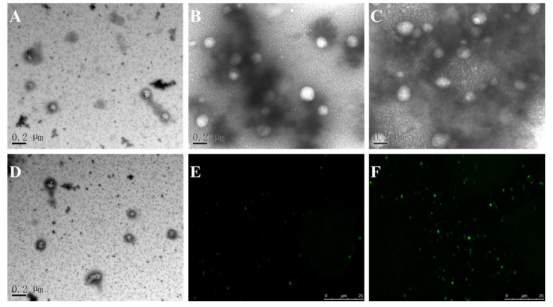
所构建的诊疗型脂质体PFBT-Dox-Lip-FA的流体动力学粒径为127.30 ± 3.20 nm,Zeta电位为−25.00 ± 2.00 mV。该粒径范围有利于纳米颗粒在肿瘤组织中的富集,而负Zeta电位则有助于维持胶体体系的稳定性。透射电子显微镜分析结果显示,Dox-Lip-FA(图1A)、Dio-Lip-FA(图1B)、PFBT-Lip-FA(图1C)及PFBT-Dox-Lip-FA(图1D)均呈现出相应的形貌特征,图A、B、C及D共用相同的标尺为0.2 μm;共聚焦激光扫描显微镜进一步观察了Dio-Lip-FA(图1E)与PFBT-Lip-FA(图1F)的形貌,图E与F共用相同的标尺为25 μm。这些表征结果共同证实了诊疗型脂质体的成功构建及其形貌的可控性。
三、温和热疗条件下的药物释放行为
尤为重要的是,在温和热疗条件下,PFBT-Dox-Lip-FA在24小时内的阿霉素释放量较Dox-Lip-FA表现出更优效果。这种快速释放特性表明,PFBT的引入与温和热疗的协同作用能够有效促进负载药物的释放,从而在肿瘤部位实现更充分的药物暴露,为后续提高抗肿瘤活性提供了药理学基础。
四、体外细胞学评价
这种快速释放特性使得PFBT-Dox-Lip-FA在MCF-7细胞中的半抑制浓度(IC50)降至16.8 ± 4.5 µg/mL,而Dox-Lip-FA在37 °C条件下的IC50为28.3 ± 3.7 µg/mL,说明诊疗型脂质体对肿瘤细胞的杀伤能力显著增强。细胞摄取实验亦表明,诊疗型脂质体在肿瘤细胞中的药物蓄积量更高,这与其更优的体外抗肿瘤活性相互印证,提示叶酸修饰与诊疗型结构有助于促进肿瘤细胞对纳米颗粒的摄取及药物的胞内蓄积。
五、体内分布与抗肿瘤疗效
在荷瘤小鼠模型中进行的体内实验显示,PFBT可准确指示脂质体在肿瘤组织中的分布情况,体现了其作为荧光探针在体内示踪方面的应用价值;此外,PFBT-Dox-Lip-FA对荷瘤小鼠的肿瘤生长具有显著抑制作用,表明该诊疗型脂质体在体内同样能够实现有效的靶向药物递送与抗肿瘤治疗。
六、体内安全性与总体评价
结合其可忽略的体内毒性,PFBT-Dox-Lip-FA成为一种兼具癌症诊断与靶向药物递送功能的实用系统。综合理化表征、药物释放、体外细胞学及体内实验结果,该诊疗型脂质体在荧光示踪、靶向递药与抗肿瘤治疗方面均表现出良好性能,具有进一步开发与应用的潜力。
╴╴╴╴╴╴╴╴╴╴╴╴╴╴╴╴╴╴╴╴╴╴╴╴╴╴╴╴╴╴╴╴╴╴╴╴╴╴╴╴╴╴╴╴╴╴╴╴╴╴╴╴╴╴╴╴╴
Abstract
This work was devoted to the development of a lipid-based theranostic nanoparticle able to simultaneously host conjugated polymer dots, doxorubicin (Dox) and folate acid (FA). Poly(9,9-dioctylfluorene-2,7-diyl-co-benzothiadiazole) (PFBT) was chosen as the fluorescent probe because of its high brightness in vitro cellular uptake study and good biocompatibility in vitro/in vivo toxicity experiment. The theranostic liposomes (PFBT-Dox-Lip-FA) exhibited a hydrodynamic size of 127.30 ± 3.20 (nm) with a zeta potential of −25.00 ± 2.00 (mV). Mostly importantly, the extent of Dox release at 24 h from PFBT-Dox-Lip-FA showed a satisfied result at the condition of mild hyperthermia compared with Dox-Lip-FA. Such rapid release led to a lower half maximal inhibitory concentration (IC50) in MCF-7 cells at 16.8 ± 4.5 (µg/mL), whereas the IC50 of Dox-Lip-FA (37 °C) was 28.3 ± 3.7 (µg/mL). The cellular uptake study also revealed higher drug accumulation in tumor cells for theranostic liposomes. In vivo studies of PFBT-Dox-Lip-FA on tumor-bearing mouse models revealed that the distribution of liposomes in tumor could be indicated accurately by PFBT. Besides, tumor-bearing mice could be significantly inhibited by PFBT-Dox-Lip-FA. Together with the negligible in vivo toxicity, PFBT-Dox-Lip-FA, was a useful system for simultaneous cancer diagnosis and targeting drug delivery.
Keywords: theranostic liposomes, conjugated polymer dots, doxorubicin, folate acid, targeting delivery