

作者:
Runjun Zhang, Renfeng Liu, Chao Liu, Lina Pan, Yuantong Qi, Juan Cheng, Jiawei Guo, Yi Jia, Jun Ding, Jianxiang Zhang, Houyuan Hu
引用瑞禧生物产品:
DSPE-PEG
PII: S0142-9612(19)30704-5
DOI: https://doi.org/10.1016/j.biomaterials.2019.119605
Reference: JBMT 119605
To appear in: Biomaterials
Received Date: 24 July 2019
Revised Date: 14 October 2019
Accepted Date: 5 November 2019
研究背景与科学假设
- 临床现状:心血管疾病(CVDs)是全球范围内发病率与死亡率攀升的核心诱因,血管炎症是其关键发病机制。
- 现存瓶颈:在血管炎症病灶实现治疗药物的精准靶向递送与可控释放,仍是当前领域的重大技术挑战。
- 核心假设:依托炎症部位酸中毒与高氧化应激的微环境特征,兼具pH与ROS双响应能力的主动靶向纳米颗粒,可作为血管炎症部位载药精准递送的高效纳米平台。
纳米载体构建与性能调控
- 材料体系:双响应纳米颗粒由pH敏感材料(ACD)与氧化响应材料(OCD)组合制备,其中OCD可通过对β-环糊精进行化学功能化便捷合成。
- 性能调控方式:仅需调整ACD与OCD的重量配比,即可灵活调控纳米颗粒的pH/ROS响应能力,制备出在炎症微环境中具备差异化水解特性的载药体系。
- 瑞禧生物供应支持:可提供pH敏感材料ACD、ROS响应材料OCD及系列功能化环糊精衍生物的定制合成服务,支持不同响应比例纳米颗粒的配方开发与小批量制备。
体外药效学验证结果
- 候选药物选择:以雷帕霉素(RAP)作为模型治疗药物,制备系列对照纳米制剂。
- 分组对比设置:设置无响应型RAP/PLGA NP、单响应型RAP/ACD NP、RAP/OCD NP,与双响应型RAP/AOCD NP进行平行对照。
- 核心结论:体外实验证实,具备最优双响应性能的RAP/AOCD NP,治疗效果显著优于其余三类对照纳米制剂。
体内动物模型药效评价
- 动物模型构建:采用大鼠颈动脉球囊损伤诱导的血管炎症模型,模拟临床动脉再狭窄病理状态。
- 被动靶向验证:静脉注射后,AOCD NP可有效在血管损伤病变部位富集,RAP/AOCD NP对大鼠动脉损伤后的新内膜增生抑制效果,显著优于其余三类对照制剂。
- 主动靶向优化:在AOCD NP表面修饰靶向IV型胶原(Col-IV)的特异性肽段klwvlpkgggc,得到TAOCD NP载体。
- 靶向增效结果:TAOCD NP在受损颈动脉部位的药物积聚量大幅提升,对应的RAP/TAOCD NP体内治疗效果,较被动靶向的RAP/AOCD NP进一步显著增强。
生物安全性综合评估
- 多维度验证体系:覆盖体外细胞培养实验、小鼠体内长期给药实验、大鼠体内治疗研究三个层面。
- 安全性结论:AOCD NP及RAP/AOCD NP均展现出良好的生物相容性,即使经过长期静脉注射干预,仍未观察到明显毒副作用。
研究最终结论
本研究开发的Col-IV靶向、pH/ROS双响应纳米载体,在动脉再狭窄及其他血管炎症类疾病的精准治疗中,可作为一种兼具高效性与高安全性的新型纳米递送平台,具备明确的临床转化潜力。
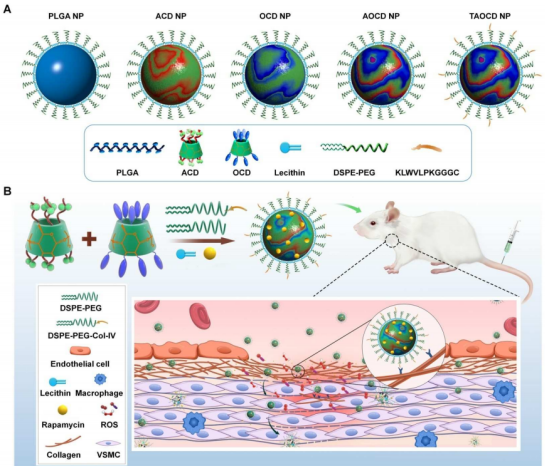
图设计与构建说明
- 图A部分:系统展示本研究中全部5种不同响应类型、不同靶向修饰状态的纳米颗粒的结构组成示意图。
- 图B部分:完整呈现基于ACD与OCD材料构建的双响应雷帕霉素靶向纳米疗法,在血管炎症疾病(动脉再狭窄)中的靶向递送与治疗作用全流程机制。
╴╴╴╴╴╴╴╴╴╴╴╴╴╴╴╴╴╴╴╴╴╴╴╴╴╴╴╴╴╴╴╴╴╴╴╴╴╴╴╴╴╴╴╴╴╴╴╴╴╴╴╴╴╴╴╴╴
ABSTRACT
Cardiovascular diseases (CVDs) remain the leading cause of morbidity and mortality worldwide. Vascular inflammation is closely related to the pathogenesis of a diverse group of CVDs. Currently, it remains a great challenge to achieve site-specific delivery and controlled release of therapeutics at vascular inflammatory sites. Herein we hypothesize that active targeting nanoparticles (NPs) simultaneously responsive to low pH and high levels of reactive oxygen species (ROS) can serve as an effective nanoplatform for precision delivery of therapeutic cargoes to the sites of vascular inflammation, in view of acidosis and oxidative stress at inflamed sites. The pH/ROS dual-responsive NPs were constructed by combination of a pH-sensitive material (ACD) and an oxidation-responsive material (OCD) that can be facilely synthesized by chemical functionalization of β- cyclodextrin, a cyclic oligosaccharide. Simply by regulating the weight ratio of ACD and OCD, the pH/ROS responsive capacity can be easily modulated, affording NPs with varied hydrolysis profiles under inflammatory microenvironment. Using rapamycin (RAP) as a candidate drug, we first demonstrated in vitro therapeutic advantages of RAP-containing NPs with optimal dual-responsive capability, i.e. RAP/AOCD NP, and a nonresponsive nanotherapy (RAP/PLGA NP) and two single-responsive nanotherapies (RAP/ACD NP and RAP/OCD NP) were used as controls. In an animal model of vascular inflammation in rats subjected to balloon injury in carotid arteries, AOCD NP could accumulate at the diseased site after intravenous (i.v.) injection. Consistently, i.v. treatment with RAP/AOCD NP more effectively inhibited neointimal hyperplasia in rats with induced arterial injuries, compared to RAP/PLGA NP, RAP/ACD NP, and RAP/OCD NP. By surface
decoration of AOCD NP with a peptide (KLWVLPKGGGC) targeting type IV collagen (Col-IV), the obtained Col-IV targeting, dual-responsive nanocarrier TAOCD NP showed dramatically increased accumulation at injured carotid arteries. Furthermore, RAP/TAOCD NP exhibited significantly potentiated in vivo efficacy in comparison to the passive targeting nanotherapy RAP/AOCD NP. Importantly, in vitro cell culture experiments and in vivo animal studies in both mice and rats revealed good safety for AOCD NP and RAP/AOCD NP, even after long-term treatment via i.v. injection. Consequently, our results demonstrated that the newly developed Col-IV targeting, pH/ROS dual-responsive NPs may serve as an effective and safe nanovehicle for precision therapy of arterial restenosis and other vascular inflammatory diseases