

作者:
Xinxin Li1,2,* Chunsheng Yang 3,4,* Yingkai Tao1,2 Xiaoyang Hou1,2 Yanqun Liu1,2 Hong Sang 3 Guan Jiang 1,2
引用瑞禧生物产品:
DSPE-PEG2000 and DSPE-PEG2000-Mal
摘要:
Purpose: A near-infrared (NIR)-triggered trans-activating transcriptional activator (TAT) based targeted drug delivery system for the combined chemo/photothermal therapy of melanoma, namely, TAT-TSL-TMZ (temozolomide)/IR820, was developed for the first time.
Methods: TAT-TSL-TMZ/IR820 liposomes were synthesized via thin-film dispersion and sonication. IR820 and TMZ were encased in the inner layer and lipid bilayer of the liposomes, respectively.
Results: Dynamic light scattering results showed that the liposomes had an average hydrodynamic size of 166.9 nm and a zeta potential of −2.55 mV. The encapsulation rates of TMZ and IR820 were 35.4% and 28.6%, respectively. The heating curve obtained under nearinfrared (NIR) laser irradiation showed that TAT-TSL-TMZ/IR820 liposomes had good photothermal conversion efficiency. The in vitro drug release curve revealed that NIR laser irradiation could accelerate drug release from TAT-TSL-TMZ/IR820 liposomes. The results of inverted fluorescence microscopy and flow cytometry proved that the uptake of TAT-TSLTMZ/IR820 liposomes by human melanoma cells (MV3 cells) was concentration-dependent and that the liposomes modified with membrane peptides were more likely to be ingested by cells than unmodified liposomes. Confocal laser scanning microscopy indicated that TATTSL-TMZ/IR820 liposomes entered MV3 cells via endocytosis and was stored in lysosomes. In addition, TAT-TSL-TMZ/IR820 liposomes exposed to NIR laser showed 89.73% reduction in cell viability.
Conclusion: This study investigated the photothermal conversion, cell uptake, colocation and chemo/photothermal effect of TAT-TSL-TMZ/IR820 liposomes.
Keywords: melanoma, liposome, TAT, photothermal therapy, temozolomide, IR820
1. 系统设计与制备工艺
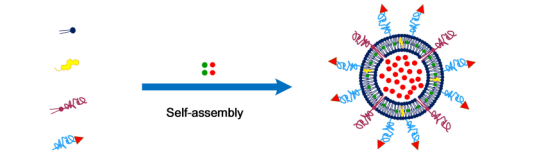
- 双重负载策略:利用脂质体的结构特性,将光热剂 IR820 包封于脂质体的亲水内层(水核),同时将化疗药物 替莫唑胺(TMZ) 嵌入疏水的脂质双分子层中。
- 表面修饰:引入穿膜肽 TAT 进行表面修饰,赋予脂质体穿透细胞膜的能力,以实现主动靶向递送。
2. 理化性质表征
- 粒径分布:平均流体动力学直径为 166.9 nm。这一纳米级尺寸有利于药物在体内的循环及通过增强渗透和滞留(EPR)效应在肿瘤部位富集。
- 表面电荷:Zeta 电位测定结果为 −2.55 mV,表明脂质体表面呈电中性或微负电,有助于维持胶体稳定性。
- 包封效率:TMZ 的包封率为 35.4%,IR820 的包封率为 28.6%,证实了该载体对两种不同性质药物的有效负载能力。
3. 光热性能与 NIR 响应性释放
- 光热转换:在近红外(NIR)激光照射下,TAT-TSL-TMZ/IR820 脂质体溶液温度迅速升高,加热曲线证实其具有良好的光热转换效率,为光热治疗提供了物理基础。
- 触发释放:体外药物释放实验显示,NIR 激光的照射能够显著改变脂质双分子层的流动性或破坏脂质体结构,从而加速 TMZ 的释放。这种“光控开关”机制有助于在肿瘤局部实现高浓度给药,降低全身副作用。
4. 细胞摄取与胞内定位机制
- 摄取效率:反向荧光显微镜及流式细胞术分析表明,细胞对脂质体的摄取呈现明显的浓度依赖性。
- TAT 的增强作用:与未修饰的脂质体相比,经 TAT 肽修饰的脂质体更容易被 MV3 细胞摄取,证实了 TAT 在促进细胞内吞方面的关键作用。
- 胞内路径:共聚焦激光扫描显微镜(CLSM)观察揭示,脂质体主要通过内吞作用进入细胞,并随后被包裹在溶酶体中。
5. 联合治疗的细胞毒性评估
- 协同杀伤:在 NIR 激光的激发下,TAT-TSL-TMZ/IR820 脂质体产生了显著的化学-光热协同效应。
- 存活率数据:实验结果显示,该联合治疗策略可使 MV3 细胞的存活率大幅降低至 10.27%(即降低了 89.73%),显示出优于单一疗法的抗肿瘤活性。