
作者:
Yueyue Fan a,b,1 , Yuexin Cui b,1 , Wenyan Hao b,1 , Mengyu Chen b , Qianqian Liu b , Yuli Wang b , Meiyan Yang b , Zhiping Li b , Wei Gong b , Shiyong Song a,* , Yang Yang b,**, Chunsheng Gao a
引用瑞禧生物产品:
DSPE-PEG2000-NHS
 ABSTRACT
Nanosuspensions, as a new drug delivery system for insoluble drugs, are only composed of a drug and a small amount of stabilizer, which is dispersed in an aqueous solution with high drug-loading, small particle size, high dispersion, and large specific surface area. It can significantly improve the dissolution, bioavailability, and efficacy of insoluble drugs. In this study, paclitaxel nanosuspensions ((PTX)NS) were prepared by an ultrasonic precipitation method, with the characteristics of simple preparation and easy repetition. With the help of a homologous targeting mechanism, a kind of glioma C6 cancer cell membrane (CCM)-coated (PTX)NS was developed and modified with DWSW peptide to obtain DWSW-CCM-(PTX)NS with the functions of BBB penetration and tumor targeting. The results showed that the cancer cell membrane could effectively camouflage the nanosuspensions so that it was not cleared by the immune system and could cross the blood-brain-barrier (BBB) and selectively target tumor tissues. Cell uptake experiments and in vivo imaging confirmed that the uptake of DWSW-CCM-(PTX)NS by tumor cells and the distribution in intracranial gliomas increased. Cytotoxicity test and in vivo anti-glioma studies showed that DWSW-CCM-(PTX)NS could significantly inhibit the growth of glioma cells and significantly prolong the survival time of glioma-bearing mice. Finally, the cancer cell membrane coating endowed the nanosuspensions with the biological properties of homologous adhesion and immune escape. This study provides an integrated solution for improving the targeting of nanosuspensions and demonstrates the encouraging potential of biomimetic nanosuspensions applicable to tumor therapy
难溶性化疗药物的血脑屏障穿透效率低、肿瘤靶向特异性差,是当前胶质瘤临床治疗面临的核心瓶颈。本研究采用超声沉淀法制备紫杉醇纳米混悬剂(PTX NS),该体系仅由药物与少量稳定剂组成,具备高载药量、小粒径、大比表面积的特性,可显著改善难溶性药物的溶出度与生物利用度。为进一步实现靶向递药,本研究构建胶质瘤C6癌细胞膜(CCM)包覆的仿生紫杉醇纳米混悬剂,并通过脂质插入法在细胞膜表面修饰DWSW靶向肽,最终得到兼具血脑屏障穿透能力与同源肿瘤靶向功能的DWSW-CCM-(PTX)NS。体外细胞实验与体内动物研究结果表明,癌细胞膜伪装结构可有效帮助递药系统逃避免疫系统清除,DWSW肽可进一步强化血脑屏障穿透能力,最终实现胶质瘤部位的高效药物富集。该制剂不仅可显著提升肿瘤细胞对药物的摄取效率,还能有效抑制胶质瘤细胞增殖,显著延长原位胶质瘤模型小鼠的生存期。本研究为纳米混悬剂的靶向功能升级提供了可行的仿生改造策略,为中枢神经系统肿瘤的精准给药提供了新的研究思路。
实验流程结构化说明版
- 紫杉醇纳米混悬剂(PTX NS)制备:采用超声沉淀法完成制备,工艺操作简便、批次重复性好,所得制剂粒径均一、分散性良好。
- 胶质瘤C6癌细胞膜(CCM)提取:通过细胞培养收集足量C6细胞,采用低渗裂解结合差速离心法,分离纯化得到高纯度的完整细胞膜组分。
- 仿生递药系统组装:将CCM与PTX NS按比例混合后,通过探头超声处理实现膜结构与纳米混悬剂的完整融合,得到CCM包覆的PTX NS;后续采用脂质插入工艺,将靶向配体DWSW肽修饰于细胞膜外表面,完成终产物DWSW-CCM-(PTX)NS的构建。
- 功能验证与药效评价:依次开展体外细胞摄取实验、血脑屏障穿透模拟实验、体内活体成像、细胞毒性测试与原位胶质瘤小鼠治疗实验,系统验证制剂的靶向递送效率与体内抗胶质瘤药效。
图
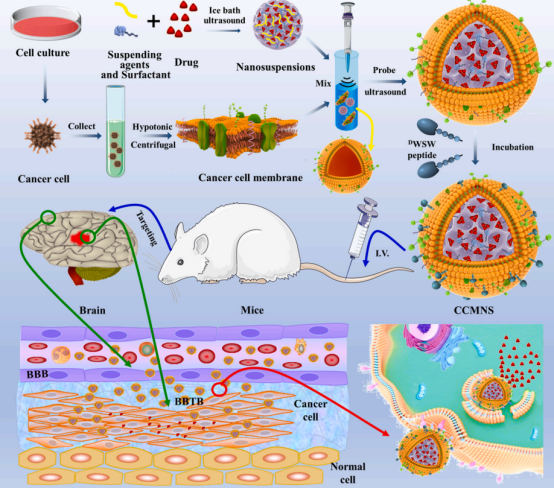
本研究的整体技术路线与作用机制如图1所示:首先通过超声沉淀法制备得到紫杉醇纳米混悬剂核心载体;随后体外培养胶质瘤C6细胞,经低渗处理与差速离心分离获得完整的癌细胞膜材料;将细胞膜与紫杉醇纳米混悬剂混合后经超声融合,完成仿生膜层的包覆,再通过脂质插入法将DWSW靶向肽修饰在膜表面,最终得到功能化仿生纳米混悬剂。对原位胶质瘤模型小鼠进行静脉给药后,该仿生制剂可依托癌细胞膜的同源识别特性逃避免疫清除,借助DWSW肽的介导高效穿透血脑屏障,精准富集于颅内胶质瘤组织,持续释放紫杉醇发挥抗肿瘤作用,最终实现抑制肿瘤生长、延长荷瘤生存期的治疗目标。