

作者:
Shanshan Li, Aiqing Xie, Hui Li, Xiang Zou, Qixiong Zhang
引用瑞禧生物产品:
DSPE-PEG2k and PLGA, 75:25, with intrinsic viscosity of 0.50-0.65
PII: S0168-3659(19)30618-2
DOI: https://doi.org/10.1016/j.jconrel.2019.10.054
Reference: COREL 10003
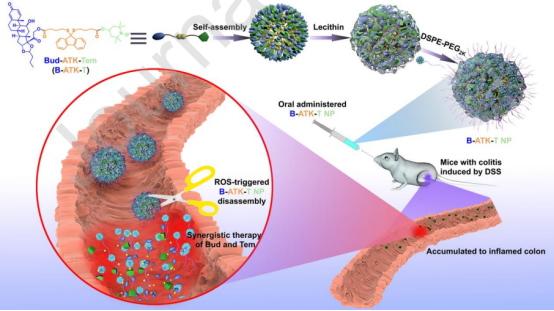
本研究设计并构建了一种具有活性氧(reactive oxygen species,ROS)响应性及氧化降解特性的自组装Janus前药纳米递送体系(Bud-ATK-Tem,B-ATK-T),旨在实现抗炎药物与抗氧化药物的协同递送,为炎症性肠病(inflammatory bowel disease,IBD)的治疗提供新策略。该前药以ROS敏感性芳香化硫缩醛(ATK)为连接单元,将抗炎药物布地奈德(budesonide,Bud)与抗氧化剂替莫尔(Tem)共价偶联,形成兼具炎症微环境响应性与双重治疗功能的前药分子。
得益于ATK结构所提供的疏水相互作用及π–π堆积效应,B-ATK-T前药能够在卵磷脂和DSPE-PEG2K辅助下自组装形成稳定的纳米颗粒(B-ATK-T NPs)。透射电子显微镜(TEM)表征结果显示,该纳米颗粒呈现均匀、规则的球形结构,粒径约为100–120 nm,具有良好的纳米尺度形貌特征。此外,该体系表现出较高的药物负载能力,其中Bud与Tem的载药量分别达到41.23%和15.55%,为实现双药高效递送提供了基础。
在药物释放方面,B-ATK-T NPs表现出显著的ROS响应性。当纳米颗粒暴露于高ROS水平的炎症微环境时,ATK连接结构发生氧化降解,促进前药分子解离并释放活性药物。在相应实验条件下,超过98%的Bud和Tem可在较短时间内释放,体现出快速、同步且按一定比例释放的特点。这种炎症微环境触发的双药释放机制,有助于实现抗炎与抗氧化作用的协同增强,同时减少药物在非炎症部位的非特异性释放。
体内实验进一步表明,口服给药后的B-ATK-T NPs能够在IBD模型小鼠的炎症结肠组织中实现被动富集,显著提高局部药物浓度,从而增强药物在病变部位的治疗作用,并有望降低全身药物暴露及相关不良反应。与游离药物治疗相比,B-ATK-T NPs能够更有效地抑制氧化应激及促炎介质的表达,减轻结肠组织炎症损伤,改善结肠炎相关病理表现,并显著降低实验动物的疾病相关死亡率。
综上所述,本研究通过将ROS响应性前药设计与纳米自组装技术相结合,成功构建了集高效载药、炎症部位富集、微环境响应性释放及抗炎–抗氧化协同治疗于一体的多功能纳米递送平台。该体系不仅提高了药物在炎症结肠组织中的局部递送效率,还通过双药协同作用增强了结肠炎的治疗效果,为IBD的精准治疗提供了新的研究思路,并在其他氧化应激相关炎症性疾病的治疗中展现出潜在应用价值。
研究创新点总结
-
ROS响应性Janus前药设计: 以芳香化硫缩醛为氧化敏感连接单元,将抗炎药物与抗氧化剂整合于同一前药分子,实现双药协同递送。
-
自组装纳米结构与高载药能力: 利用疏水相互作用及π–π堆积效应形成纳米颗粒,减少对传统惰性载体的依赖,并实现较高的药物负载量。
-
炎症微环境触发的精准释放: 利用炎症部位ROS水平升高的特征,促进前药氧化降解,实现双药同步释放。
-
口服递送与炎症结肠富集: 通过纳米递送体系提高药物在炎症结肠组织中的局部浓度,增强治疗效果并降低潜在的全身毒性。
-
抗炎与抗氧化协同治疗: 通过同时抑制炎症反应和氧化应激,改善结肠炎相关病理损伤,提高整体治疗效果。
研究意义: 该研究突破了传统单一药物治疗在作用机制和局部递送效率方面的局限,利用炎症微环境响应性纳米前药实现抗炎与抗氧化的协同干预,为开发新型口服IBD治疗制剂提供了重要参考。
╴╴╴╴╴╴╴╴╴╴╴╴╴╴╴╴╴╴╴╴╴╴╴╴╴╴╴╴╴╴╴╴╴╴╴╴╴╴╴╴╴╴╴╴╴╴╴╴╴╴╴╴╴╴╴╴╴
Abstract
A self-assembled and oxidation-degradable Janus-prodrug, termed as Bud-ATK-Tem (B-ATK-T), was fabricated by ROS-responsive aromatized thioketal (ATK) linked anti-inflammatory drug budesonide (Bud) and antioxidant tempol (Tem). Benefiting from the hydrophobic interactions and π-π stacking interactions of ATK, prodrug B-ATK-T could self-assemble into nanoparticles (NP) in water containing lecithin and DSPE-PEG2K. The morphology of B-ATK-T NP (approximate 100-120 nm) was confirmed to be regular spherical by transmission electron microscope. B-ATK-T NP was endowed high drug loading content with 41.23% for Bud and 15.55% for Tem. The rapid drug release from B-ATK-T NP proceeded in an extensive reactive oxygen species (ROS)-dependent manner. More than 98% of Bud and Tem in B-ATK-T NP could release in the mimic inflammation microenvironment or phorbol-12-myristate-13-acetate (PMA)-stimulated macrophages within short time. The release of drugs in a simultaneous and proportional manner ensures that B-ATK-T NP can increase the combined efficacy of anti-inflammation and anti-oxidation. It is worth noting that B-ATK-T NP could be passively accumulated and dramatically increasing the maximum drugs concentration in the inflamed colon of mice with inflammatory bowel disease (IBD) by oral route, and avoiding potential systemic side effects. B-ATK-T NP could not only relieve colitis via inhibiting the expression of oxidative and proinflammatory mediators more than combination of free drugs, but also significantly reduce colitiscaused death. Taken together, the self-assembled, Janus-prodrug B-ATK-T NP is a promising candidate therapies for IBD, even for other inflammatory diseases.
Keywords: self-assembled; ROS-responsive; Janus-prodrug; site-specific therapy; inflammatory bowel disease