

作者:
Shengyong Geng, Zhibin Li, Rui Zhang, Wenhua Zhou, Guanghong Luo,
Paul K. Chu, Xue-Feng Yu
引用瑞禧生物产品:
DSPE-PEG2000-cRGD
PII: S1385-8947(20)33998-X
DOI: https://doi.org/10.1016/j.cej.2020.127879
Reference: CEJ 127879
To appear in: Chemical Engineering Journal
Received Date: 20 October 2020
Revised Date: 13 November 2020
Accepted Date: 23 November 2020
Abstract
Treatment of drug-resistant tumors is a great challenge and nanoplatforms combining advanced therapeutic functions have many advantages in offering efficient treatment. However, the reported fabrication of nanoplatforms for multi-modal therapy of tumors is complicated or even uncontrollable since several kinds of therapeutic agents need to be assembled into the nanoparticles. Herein, black phosphorus (BP)-based photosensitive nanocapsules (BP-PNCs) are designed as a highly efficient nanoplatform against resistant tumors by integrating the inherent photothermal and chemotherapeutic effects of BP. BP PNCs are synthesized by encapsulating BP quantum dots (BPQDs) into the core of
liposome and DSPE-PEG2000-cRGD is incorporated into the liposomal bilayers to render BP-PNCs with high cellular uptake and effective in vivo tumor targeting capability after intravenous injection. In vitro and in vivo assessments demonstrate that BP-PNCs in conjunction with near-infrared (NIR) light irradiation lead to complete obliteration of resistant A549R tumors. The excellent anti-cancer efficacy stems from the synergistic
therapeutic effects arising from the NIR light induced BP photothermal effects, which result in hyperthermia ablation and trigger the liposome phase transition to release internal BPQDs to perform BP chemotherapeutic effects. The expression inhibition of P-gp by
hyperthermia further improves the chemotherapeutic efficiency. BP-PNCs with a simple structure and intrinsic multi-functionalities have great potential in treating resistant tumors and our results provide insights into the design of multifunctional nanoplatforms for biomedicine.
Keywords: black phosphorus, liposomes, synergistic therapy, resistant tumor ablation
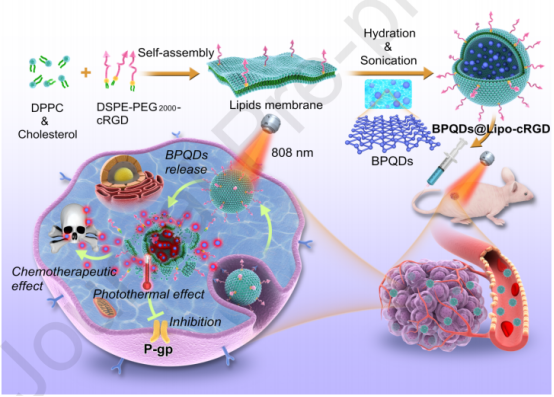
图 1展示了 BP-PNCs(BPQDs@Lipo-cRGD)的构建流程及其用于耐药肿瘤协同消融的作用机制。首先以黑磷量子点(BPQDs)作为内核功能组分,利用脂质双分子层自组装形成脂质囊泡结构,将 BPQDs 包载于脂质体水相内核;同时在脂质膜层中插入靶向修饰分子 DSPE-PEG2000-cRGD,借助 DSPE 的疏水链锚定在磷脂双分子层,亲水 PEG 链提升纳米胶囊在血液循环中的稳定性、降低网状内皮系统的非特异性截留,末端 cRGD 肽可特异性识别肿瘤细胞表面高表达的整合素 αvβ3,赋予 BP-PNCs 主动肿瘤靶向能力,终得到结构均一的黑磷光敏纳米胶囊 BP-PNCs。
经静脉给药后,BP-PNCs 依靠 cRGD 介导的靶向识别作用富集至耐药肿瘤组织,并被耐药 A549R 肿瘤细胞高效内吞进入胞内。在近红外光(NIR)照射条件下,纳米胶囊中的 BPQDs 发挥本征光热转换能力,将光能转化为局部热能,一方面产生高温直接对肿瘤细胞进行光热消融;另一方面,局部升温诱导脂质双分子层发生相变,脂质膜通透性显著提升,加速囊泡内部 BPQDs 的胞内释放,释放后的 BPQDs 进一步发挥化疗作用。与此同时,光热产生的温和高温能够下调或抑制耐药肿瘤细胞膜上 P - 糖蛋白(P-gp)的外排功能,减弱 P-gp 对 BPQDs 的泵出效应,克服肿瘤多药耐药屏障,提升胞内有效药物浓度,实现光热消融、脂质体相变控释、P-gp 抑制、黑磷化疗多重效应耦合的协同抗肿瘤效果,终实现耐药肿瘤的高效清除。该示意图清晰呈现了 BP-PNCs 从纳米制备、体内靶向富集到胞内响应释放、协同杀伤耐药肿瘤细胞的完整逻辑链条,直观解释了该一体化纳米平台无需复杂多药共载,依靠黑磷固有功能结合脂质体响应特性实现耐药肿瘤消融的设计思路。